

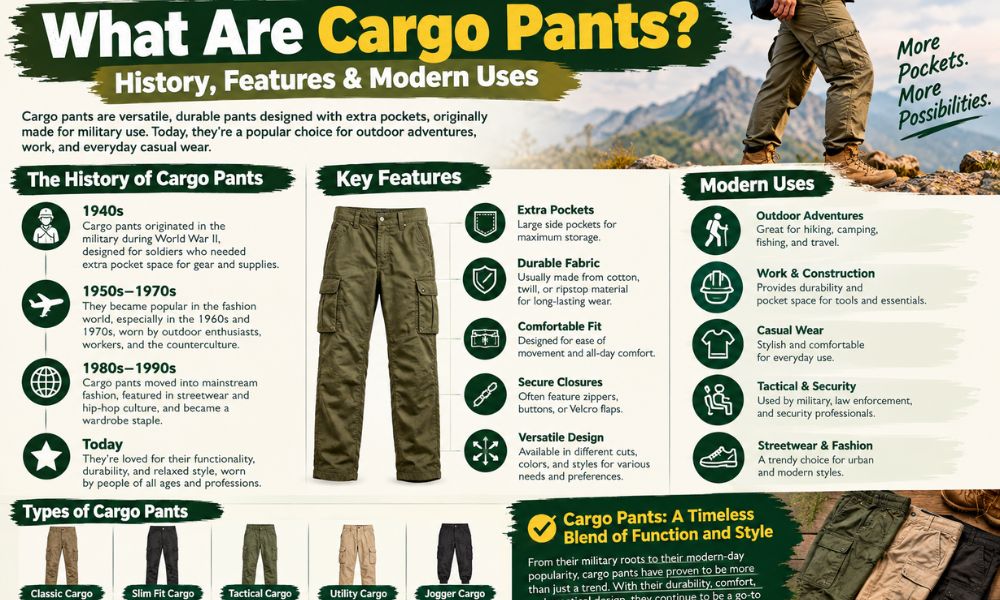
Cargo pants are utility-focused trousers built around large external pockets, typically positioned on the thigh, designed to carry tools and equipment without a bag. They originated in British and U.S. military uniforms in the late 1930s and 1940s, then moved into workwear, outdoor gear, and streetwear over the following decades.
Ask someone what cargo pants are, and most will point to the pockets. That’s the right instinct, but it’s only part of the story. Cargo pants are defined by a design philosophy that puts function ahead of form — reinforced construction, durable fabric, and storage built directly into the garment.
That philosophy has military roots. Cargo pants were developed to solve a specific problem: soldiers needed to carry gear without relying on a separate bag, and the solution was engineered directly into the trouser. From there, the design spread into workwear, hiking gear, and eventually mainstream fashion, where it remains a fixture today.
This guide breaks down what cargo pants are, where they came from, what separates a genuine cargo pant from an imitation, and how to choose a pair suited to your needs. Army Navy USA has outfitted military, law enforcement, and skilled trades professionals with military clothing and workwear since 1979, and the same principles that guided the original design still apply to buying decisions today.
What Are Cargo Pants?
Cargo pants are trousers built with large external pockets designed for carrying tools, equipment, or personal items. The defining feature is storage: multiple pockets, typically positioned along the thigh, sized to hold items too bulky for a standard trouser pocket.
Beyond the pockets, cargo pants share several consistent design traits:
- A relaxed, practical fit that allows freedom of movement
- Durable, often heavyweight fabric such as cotton twill, cotton-polyester blends, or ripstop nylon
- Reinforced stitching at stress points like the knees and pocket seams
- A utility-first silhouette, prioritizing function over a tailored look
Ordinary trousers are built primarily for appearance and everyday comfort. Cargo pants are built to perform under load — carrying a radio, a multitool, or a notepad without sagging or tearing. That distinction is what separates true cargo trousers from pants that simply add a decorative flap for style.
Where Did Cargo Pants Originate?
Cargo pants originated in British military battledress in the late 1930s. The British Army introduced cargo-style trousers as part of its Battledress uniform, adding large pockets so soldiers could carry maps, ammunition, and field supplies while keeping their hands free.
The U.S. military adapted the design shortly after, most notably for paratroopers during World War II. Airborne troops needed to carry extra gear during jumps, and standard uniform pants didn’t offer enough storage. The U.S. Army’s M-1942 paratrooper trousers added large cargo pockets to the thigh, a direct response to that operational need.
This military utility influence didn’t stay confined to the battlefield. Surplus military clothing became widely available after the war, and by the mid-20th century, cargo-style trousers had started appearing in civilian wardrobes — a pattern that repeated with other military clothing staples like the M-65 field jacket. What began as a solution for paratroopers became a template that workwear brands and, later, fashion designers would return to again and again.
What Are the Main Features of Cargo Pants?
Cargo pants share a set of defining features regardless of brand or era. Together, these features distinguish genuine utility trousers from pants that only borrow the cargo aesthetic.
- Large external cargo pockets. These are the signature feature, sized to hold tools, phones, or field equipment.
- Thigh-level pocket placement. Positioning pockets on the thigh keeps items accessible while standing, kneeling, or moving.
- Secure closures. Flaps, buttons, snaps, or hook-and-loop fasteners keep pocket contents from falling out during movement.
- Bellows-style construction. Many cargo pockets expand outward, increasing storage capacity without limiting mobility.
- Durable fabrics. Cotton, cotton-polyester blends, and ripstop synthetics resist tearing and abrasion.
- Reinforced stitching. Double or triple stitching at seams and pocket edges withstands repeated stress.
- Room for movement. A roomier cut through the leg and seat supports bending, climbing, and kneeling.
- Multiple storage compartments. Beyond the main cargo pockets, most designs include standard front and back pockets as well.
Each feature exists for a functional reason, not a stylistic one. That’s the throughline connecting a 1940s paratrooper trouser to a modern pair of work cargo pants.
What Are Cargo Pants Used For?
Cargo pants are used wherever hands-free storage and durability matter more than a tailored fit. Their applications span several distinct categories:
- Military and tactical use: Carrying field equipment, ammunition, and communication devices
- Workwear and trades: Holding tools, fasteners, and small hardware on construction and job sites
- Outdoor and recreation: Storing maps, multi-tools, and snacks during hiking or camping
- Travel: Keeping passports, chargers, and essentials accessible without a bag
- Casual wear and streetwear: Functioning as an everyday style choice with a utilitarian look
Choose cargo pants over a standard trouser if you regularly need to carry small tools or equipment without a bag. If storage isn’t a priority, a standard-fit pant will typically offer a closer, more streamlined look.
Military Cargo Pants
Military cargo pants are built to specification for active-duty and tactical use, often meeting standards like MIL-SPEC construction. They typically feature heavier fabrics, muted colorways, and pocket configurations designed around field equipment.
Tactical Cargo Pants
Tactical cargo pants adapt the military template for law enforcement, security, and civilian tactical use. They frequently include features like articulated knees, reinforced seat panels, and compatibility with knee pads.
Work Cargo Pants
Work cargo pants prioritize job-site durability, with abrasion-resistant fabric and pockets sized for hand tools, tape measures, and fasteners. Brands like Carhartt and Dickies are known for this category.
Outdoor Cargo Pants
Outdoor cargo pants are built for hiking, camping, and fieldwork, often using lighter, quick-drying, or water-resistant fabrics compared to military or work variants.
Casual and Fashion Cargo Pants
Casual cargo pants borrow the visual language of utility clothing — pockets, flaps, drawstrings — without necessarily matching the durability or functional storage of military or work versions.
Military Cargo Pants vs. Modern Cargo Pants
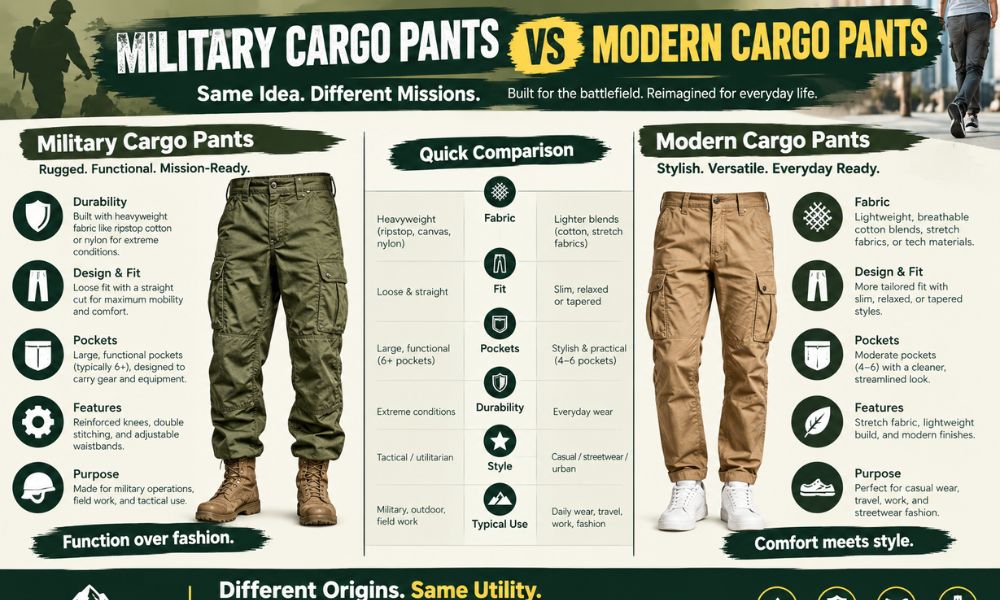
Military cargo pants prioritize function above all else, while modern cargo pants often adapt the same visual features for comfort, fashion, or lighter-duty use.
| Feature | Military Cargo Pants | Modern Cargo Pants |
| Primary Purpose | Field duty, tactical carry | Fashion, casual wear, light utility |
| Pocket Design | Large, functional, MIL-SPEC placement | Often smaller or decorative |
| Fabric | Heavyweight cotton, ripstop, ANSI/MIL-SPEC compliant materials | Lighter cotton blends, denim, stretch fabrics |
| Fit | Relaxed for mobility and gear compatibility | Slim, tapered, or relaxed for style |
| Styling | Muted, tactical colorways | Wide range of colors and washes |
Choose military-grade cargo pants if durability and genuine storage capacity matter more than a fashion-forward cut. Choose a modern, fashion-oriented pair if you want the aesthetic without the weight or bulk of true field trousers.
Are Cargo Pants Still Popular Today?
Cargo pants remain popular today, having moved well beyond their original military application. What started as a functional military garment has become a mainstay across workwear, outdoor gear, and streetwear fashion.
The reasons for that staying power are practical as much as stylistic. Skilled trades workers rely on cargo pants for genuine on-the-job storage. Outdoor enthusiasts value the durability and pocket capacity for field use. And in fashion, cargo pants have cycled in and out of trend status for decades, currently sitting firmly back in mainstream rotation. Utility clothing tends to endure because the underlying need — carrying things efficiently — never really goes away.
How to Choose Cargo Pants
Choosing the right cargo pants starts with identifying your primary use case, since military, work, outdoor, and fashion versions are built around different priorities.
Work through these factors before buying:
- Define your intended use. Military duty, job-site work, hiking, or everyday wear each call for a different build.
- Check the fabric. Ripstop and heavyweight cotton hold up to abrasion; lighter blends prioritize comfort over durability.
- Evaluate pocket placement and capacity. Confirm the pockets fit what you actually need to carry.
- Assess the fit. A relaxed fit supports mobility; a tapered fit favors a cleaner look.
- Look for reinforced construction. Double stitching and reinforced seams matter if the pants will see heavy use.
- Match the pants to your conditions. Water-resistant or breathable fabrics matter for outdoor or seasonal use.
- Confirm sizing. Cargo pants often run roomier than standard trousers, so check size charts rather than assuming your usual size.
If you need pants that hold up to daily wear on the job or in the field, prioritize reinforced construction and durable fabric over styling. Army Navy USA’s military pants and workwear selections are built around that standard.
Find Cargo Pants Built for Real Use
Cargo pants have carried their military origins into nearly every corner of modern clothing, from job sites to hiking trails to everyday streetwear. Understanding what are cargo pants really comes down to recognizing the design intent behind them: storage, durability, and mobility, engineered directly into the garment rather than added as an afterthought.
If you’re shopping for pants that need to perform, not just look the part, start with a retailer that understands the difference. Army Navy USA has supplied military clothing and tactical clothing to military, law enforcement, and skilled trades professionals since 1979, alongside military gear and Army and Navy clothing built to the same standards. Browse the current cargo pants selection to find a pair matched to your intended use.
Frequently Asked Questions
What are cargo pants?
Cargo pants are utility trousers built with large external pockets, typically on the thigh, designed to carry tools or equipment without a separate bag. They’re defined by durable fabric, reinforced stitching, and a relaxed fit for mobility.
Why are cargo pants called cargo pants?
Cargo pants are named for their pockets’ resemblance to cargo holds — storage compartments built into the garment itself rather than a separate bag. The term reflects the trousers’ core function: carrying cargo, or gear, directly on the body.
What are cargo pants used for?
Cargo pants are used for carrying tools, equipment, and personal items in settings that require hands-free storage. Common uses include military and tactical duty, construction and trades work, hiking and outdoor recreation, travel, and everyday casual wear.
Are cargo pants military pants?
Not all cargo pants are military pants, though the design originated in military uniforms. Genuine military cargo pants are built to specific standards for field use, while many modern cargo pants adapt the same look for fashion or lighter-duty purposes.
What is the difference between cargo pants and regular pants?
Cargo pants include large external pockets, durable fabric, and reinforced construction built for carrying tools and equipment. Regular pants are designed primarily for comfort and appearance, without the same storage capacity or heavy-duty build.
