

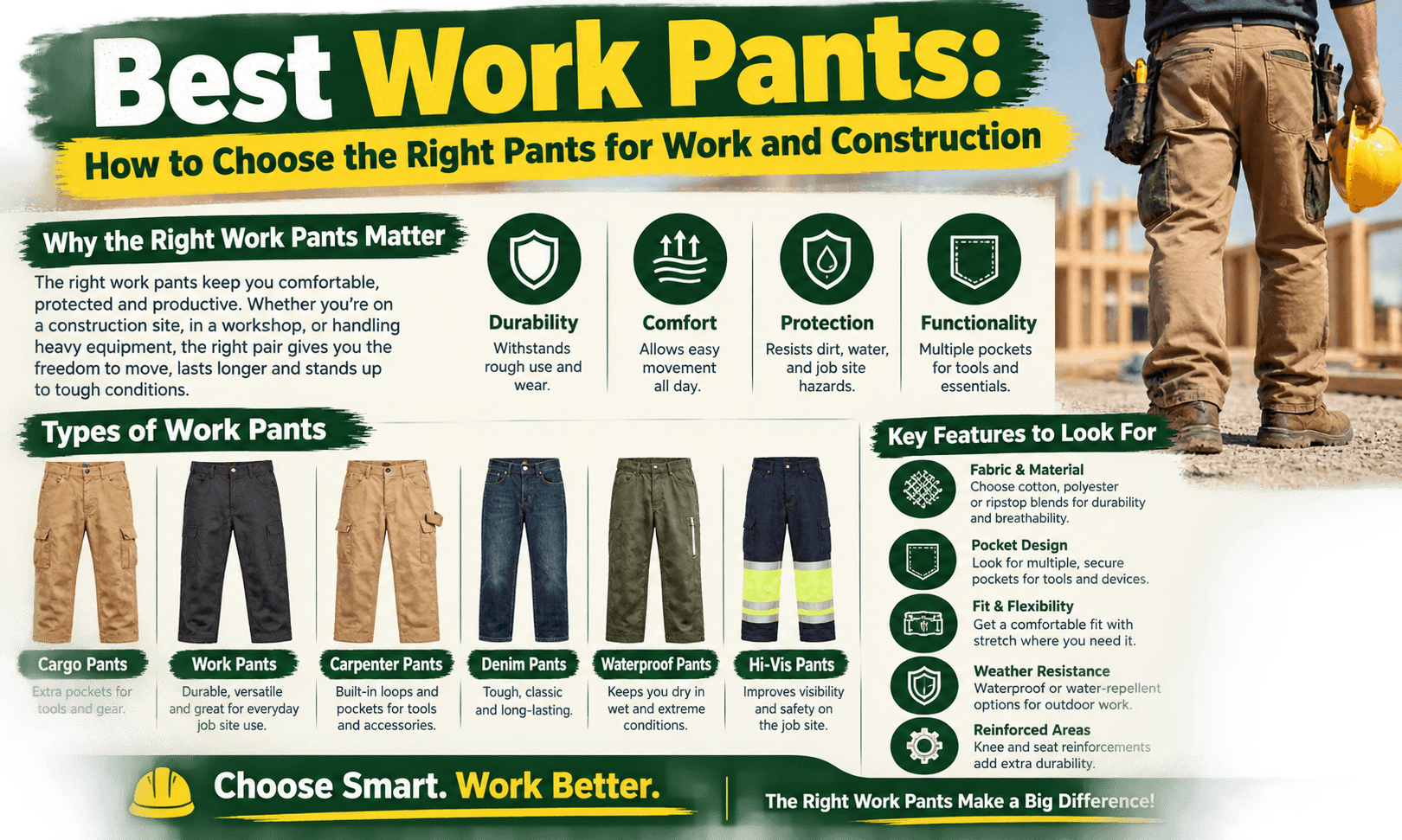
The best work pants combine durable fabric like ripstop cotton or cotton-poly blends, reinforced stitching at stress points, and enough pocket capacity for tools without restricting movement. The right choice depends on your job: construction and trades work call for reinforced knees and hammer loops, while warehouse or light industrial roles prioritize stretch fabric and mobility. No single pair works for every job site.
Choosing work pants isn’t like buying jeans for the weekend. A poorly chosen pair rips at the knee during a crawl space job, traps heat on a summer roof, or lacks the pocket to hold a tape measure exactly when you need it. Getting this decision right means fewer replacements, fewer distractions on the job, and clothing that actually supports the work instead of getting in the way.
This guide walks through what separates durable work pants from ordinary pants, how to match features to your specific job, and what to check before you buy. You’ll also find a comparison table breaking down work pants versus regular pants, a buying checklist, and answers to the questions people ask most often about workwear.
What Are the Best Work Pants?
The best work pants are built around three things: fabric durability, reinforcement at high-wear points, and functional storage. Ripstop cotton, canvas duck, and cotton-poly blends resist tearing and abrasion far better than standard cotton twill. Reinforced knees, double-stitched seams, and bar-tacked pockets hold up under repeated kneeling, crawling, and tool use.
There isn’t one “best” work pant for every trade. A framer kneeling on rough subfloor all day needs different reinforcement than an electrician who needs quick access to a dozen small tools. That’s why the decision should start with the job, not the brand.
What Makes a Good Pair of Work Pants?
A good pair of work pants protects the wearer while supporting the specific movements their job demands. Four qualities separate occupational clothing from everyday pants:
- Abrasion-resistant fabric. Materials like ripstop cotton or heavyweight canvas resist tearing when dragged across rough surfaces, gravel, or metal edges.
- Reinforced stress points. Double-layered knees, bar-tacked belt loops, and triple-stitched seams prevent the pants from failing exactly where the job stresses them most.
- Functional pocket layout. Hammer loops, rule pockets, and multiple utility pockets keep tools within reach without needing a separate tool belt.
- Range of motion. Gusseted crotches, articulated knees, or added stretch fibers let you crouch, climb, and reach without the fabric binding.
Each of these matters differently depending on the trade, which is why the next section breaks work pants down by job type.
How to Choose the Best Work Pants for Different Jobs
The right work pants match the physical demands and hazards of the job, not just personal style. Consider these common scenarios:
- Construction and framing: Prioritize reinforced knees, a hammer loop, and heavyweight canvas or ripstop fabric that can handle kneeling on rough surfaces and contact with lumber and fasteners.
- Electrical and plumbing: Look for multiple small utility pockets for wire strippers, pliers, and fittings, along with fabric flexible enough for crawling into tight spaces.
- Warehouse and logistics: Stretch-woven fabric and a relaxed fit support constant bending, lifting, and walking across long shifts.
- Welding and metalwork: Flame-resistant (FR) fabric is essential to protect against sparks and heat, even if it sacrifices some flexibility.
- Landscaping and outdoor labor: Water-resistant treatments and reinforced seat and knee panels hold up against dirt, moisture, and repeated crouching.
Once you’ve identified the demands of your specific job, you can narrow the fabric and feature list from there. Browse a dedicated work pants selection to compare options built for these different use cases side by side.
Best Work Pants for Men: Features to Look For
Men’s work pants typically prioritize a straight or relaxed fit through the hip and thigh, paired with a longer rise to accommodate tool belts and movement without excessive gapping at the waist. Look for double-front construction—an extra layer of fabric across the thighs and knees—on pants intended for kneeling-heavy trades like flooring, framing, or masonry.
Carpenter-style pants with a hammer loop and rule pocket remain a standard choice among tradespeople for a reason: they put tools exactly where a worker reaches for them most often. Carpenter jeans built with heavyweight denim or duck canvas add durability without sacrificing that functional pocket layout.
Best Work Pants for Women: Finding the Right Fit
Work pants for women should follow the same durability standards as men’s workwear, but built on a fit designed for a woman’s proportions rather than a resized men’s pattern. A properly fitted pair sits correctly at the natural waist, avoids excess bagging through the hip, and keeps the rise short enough to prevent bunching under a tool belt.
Fit matters as much as fabric here: pants that gap at the waist or restrict the knee create the same safety and comfort problems regardless of who’s wearing them. Brands like Carhartt and Dickies have expanded women’s-specific cuts in recent years, addressing a gap that left many tradeswomen wearing pants designed around a different body shape entirely. When comparing options, check the product description for “women’s fit” or “women’s cut” rather than assuming a smaller men’s size will fit the same way.
What Are the Best Pants for Work? Work Pants vs. Regular Pants
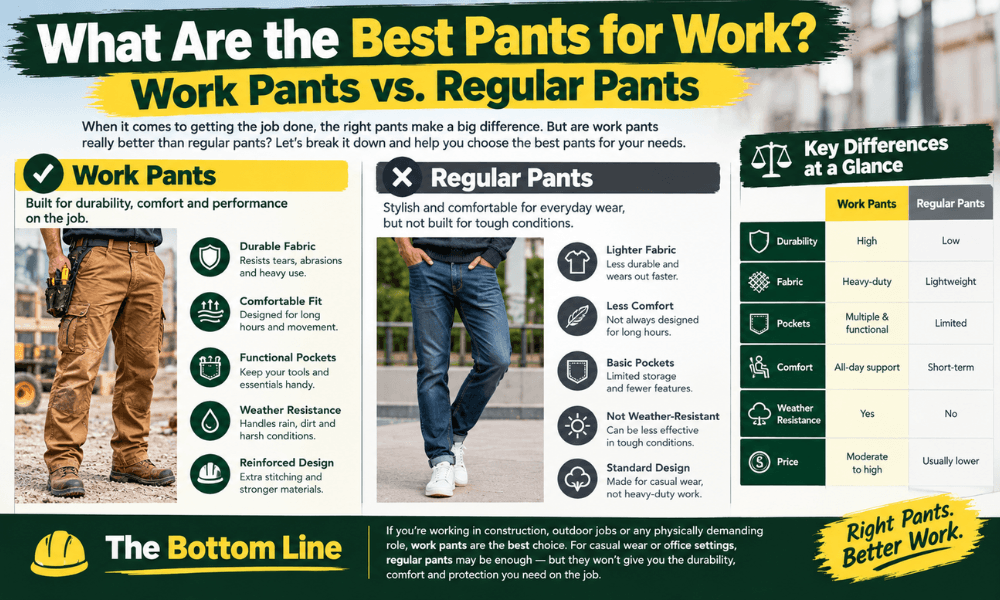
Regular pants and true work pants may look similar on a hanger, but they perform very differently once they hit a job site. The table below breaks down the core differences.
| Feature | Work Pants | Regular Pants |
| Durability | Built with abrasion-resistant fabric rated for repeated wear and tear | Designed for everyday wear, not repeated abrasion |
| Pockets | Multiple utility pockets, hammer loops, rule pockets | Standard front/back pockets only |
| Mobility | Gusseted seams or stretch panels for crouching and reaching | Limited range of motion under strain |
| Reinforcement | Double-stitched seams, reinforced knees and seat | Single-stitched seams, no reinforcement |
| Fabric | Ripstop cotton, canvas duck, cotton-poly blends | Cotton twill, chino fabric, denim |
If your day involves kneeling, climbing, or carrying tools, regular pants will wear out fast and offer nowhere to put your gear. Choose true work pants if durability and storage matter more than a dressed-up look; choose regular pants only for light-duty office or retail environments where neither is a real concern.
What Fabric Is Best for Work Pants?
The best fabric for work pants depends on the balance you need between durability, breathability, and flexibility. Ripstop cotton resists tearing and stays cool in warm conditions, making it a strong choice for outdoor labor and construction. Canvas duck is heavier and more abrasion-resistant, suited to rougher trades like masonry or logging, though it breathes less well in heat. Cotton-poly blends add stretch and reduce wrinkling, which benefits jobs requiring frequent bending and reaching, such as warehouse work.
For jobs involving flame or heat exposure, flame-resistant (FR) treated fabric is a non-negotiable safety requirement rather than a comfort preference. Stretch workwear fabrics—cotton blended with spandex or elastane—have also become more common in recent years as manufacturers respond to demand for mobility without sacrificing durability.
Essential Features to Look for in Work Pants
Beyond fabric, a handful of construction details separate durable pants from ones that won’t last a season:
- Reinforced knees: Double-layered fabric or built-in knee pad pockets protect against repeated kneeling.
- Bar-tacked stress points: Reinforced stitching at pocket corners and belt loops prevents tearing under load.
- Gusseted crotch: An extra fabric panel that reduces strain and prevents blowouts when reaching or climbing.
- Multiple pocket types: A mix of deep utility pockets, a rule pocket, and a hammer loop covers most trade needs.
- Adjustable waistband: Useful for layering over base layers in cold weather or adjusting fit through the workday.
Prioritize the features that match your specific hazards first, then treat the rest as helpful extras.
How Should Work Pants Fit?
Work pants should fit loose enough to allow a full range of motion but not so loose that fabric catches on equipment or tools. The waist should sit comfortably without a belt digging in during a full shift, and the rise should be long enough to prevent gapping when bending or crouching.
Check the knee placement specifically: knee reinforcement patches should sit at your actual knee when crouched, not several inches above or below. A pair that fits well standing but rides up when kneeling will still leave the knee exposed to wear during the exact motion the reinforcement was meant to protect.
How to Choose Work Pants for Different Weather Conditions
Weather conditions change which features matter most, even for the same job. In hot climates, lightweight ripstop cotton with ventilation panels keeps workers cooler than heavier canvas. In cold conditions, a slightly roomier fit accommodates thermal layers underneath, and a water-resistant or wind-resistant finish adds protection against exposure. For wet or muddy job sites, a durable water repellent (DWR) coating helps pants shed moisture instead of soaking through, which matters for both comfort and preventing fabric breakdown over time.
Layering strategy matters as much as the pants themselves: a mid-weight pant paired with thermal base layers often performs better across a range of temperatures than a single heavyweight pair meant to handle everything alone.
Work Pants Buying Checklist
Before buying, run through this checklist to confirm the pants match your job:
- Fabric matches the job’s abrasion, heat, or flame-resistance requirements
- Knees are reinforced and positioned correctly when crouched
- Pocket layout includes the specific tools you carry daily
- Fit allows full range of motion without excess bagging
- Waistband and rise accommodate a tool belt if needed
- Fabric weight matches the season and climate you work in
- Sizing is based on the correct men’s or women’s fit pattern
Frequently Asked Questions About Work Pants
What is the most durable fabric for work pants?
Canvas duck and heavyweight ripstop cotton are among the most durable fabrics for work pants, resisting tears and abrasion from repeated contact with rough surfaces. Canvas duck offers slightly more abrasion resistance, while ripstop cotton breathes better in warm conditions.
Are carpenter jeans the same as work pants?
Carpenter jeans are a specific style of work pants built with denim or duck canvas, featuring a hammer loop and rule pocket. They’re designed primarily for trades like framing and finish carpentry, while broader work pants categories include other fabrics and pocket layouts for different jobs.
Do work pants need to be flame-resistant?
Only jobs involving open flame, sparks, or high heat exposure—such as welding or electrical work near live circuits—require flame-resistant (FR) fabric. For most other trades, standard durable cotton or cotton-poly blends provide sufficient protection.
How often should construction work pants be replaced?
Construction work pants should be replaced when reinforced knee panels wear through, seams begin fraying at stress points, or fabric thins enough to reduce protection. Heavy daily use in rough conditions typically shortens this timeline compared to lighter-duty jobs.
Can women wear men’s work pants?
Women can wear men’s work pants, but a women’s-specific cut typically fits better through the waist and hip, reducing gapping and bunching under a tool belt. Fit affects both comfort and how well reinforced areas like the knee align during actual work movements.
Choosing Work Pants That Match the Job
The right work pants come down to matching fabric, reinforcement, and pocket layout to the actual demands of your trade. A pair built for framing won’t necessarily serve an electrician well, and a warehouse-friendly stretch pant won’t hold up on a masonry site. Use the job itself as your starting filter, then narrow down by fabric weight, fit, and weather conditions.
Find the Right Workwear for Your Job
Durable work pants, carpenter jeans, and reinforced workwear from trusted brands are available at Army Navy USA, including options from Carhartt and Dickies built for construction, trades, and industrial job sites. Browse the full workwear selection to find the pair built for the work you actually do.
