

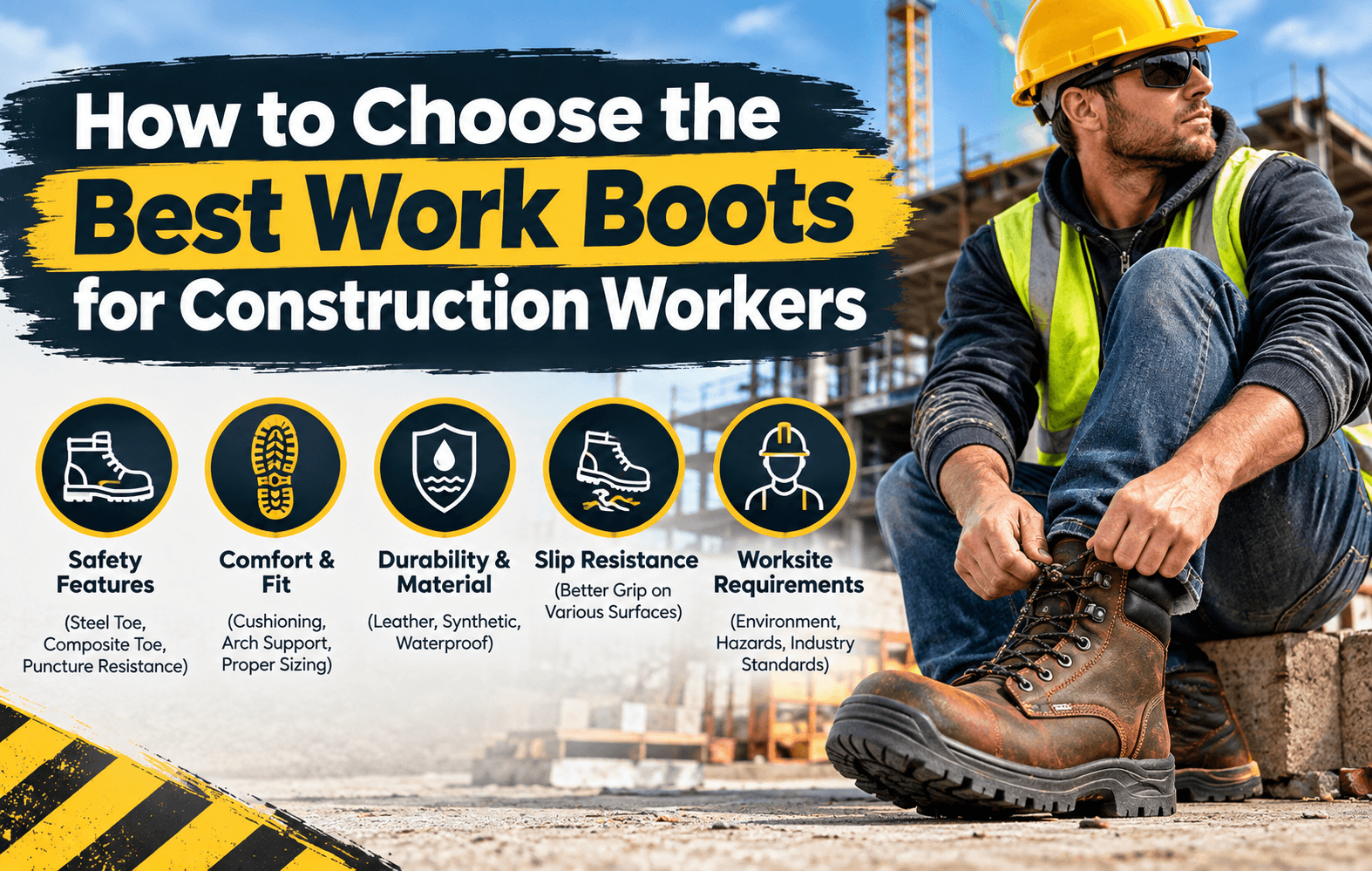
The best work boots for construction depend on the hazards you face, the surfaces you work on, the weather you deal with, the safety standards your site requires, and how comfortable the boots feel after a long shift. The most expensive or most popular pair is not automatically the right one. The right boots match your actual job. That means factoring in falling objects, sharp debris, slippery ground, electrical risks, and the eight to twelve hours you spend on your feet.
Let’s break down exactly what to look for so you can choose with confidence.
What Makes a Good Construction Work Boot?
A good construction work boot protects you from real jobsite hazards while staying comfortable enough to wear all day. Construction workers should choose footwear based on the hazards they face, including falling objects, puncture risks, slippery surfaces, electrical hazards, weather exposure, and long hours standing or walking.
Here are the core features worth evaluating.
1. Safety Toe Protection
A safety toe shields your foot from impact (dropped tools, materials, equipment) and compression (heavy objects rolling or pressing down). You’ll mostly choose between two options:
Steel toe: Traditional, strong, and proven. Steel is heavier and conducts temperature, so it can feel colder in winter and warmer in heat.
Composite toe: Made from materials like carbon fiber, plastic, or Kevlar. Usually lighter and non-metallic, which some workers prefer for comfort and reduced temperature transfer.
Both can meet the same impact and compression standards when certified. Choose based on your workplace hazards and your employer’s requirements. If you’re comparing specific options, it may help to browse brands that offer multiple safety configurations, such as Timberland PRO work boots and safety footwear.
OSHA requires protective footwear in workplaces where employees face hazards such as falling or rolling objects, objects that could pierce the sole, or certain electrical risks. Always check your site’s specific requirements against the applicable standards.
2. Slip-Resistant Outsole
Traction keeps you upright on the surfaces construction throws at you: wet concrete, mud, dust, oily areas, uneven ground, and scattered debris. A slip-resistant outsole with a deep, well-designed tread pattern grips these surfaces and helps prevent falls.
OSHA identifies slippery surfaces as a footwear hazard and recommends slip-resistant soles where appropriate. If your job moves between indoor slab work and muddy outdoor terrain, prioritize an aggressive tread that clears debris.
3. Puncture Resistance
A puncture-resistant midsole guards the bottom of your foot against nails, screws, metal fragments, and sharp construction debris. On sites with exposed fasteners or demolition materials, this feature can prevent a serious injury.
Puncture protection sits between the insole and outsole and doesn’t add much bulk. If you regularly walk across framing sites or debris-heavy areas, it’s worth having.
4. Waterproofing and Water Resistance
Waterproof boots keep your feet dry in rain, mud, snow, and wet concrete work. But not every worker needs them. In hot climates or dry indoor environments, breathable, non-waterproof boots may keep your feet cooler and more comfortable.
Consider waterproofing if you work:
- In frequent rain or snow
- On wet or muddy job sites
- Around standing water or concrete
Skip full waterproofing if you work mostly in hot, dry conditions where breathability matters more. Waterproof boots are not always better; the right choice depends on your environment. If you’re shopping by feature and brand, collections like Matterhorn work boots include waterproof, steel toe, composite toe, and electrical hazard options.
5. Durability
Construction is hard on footwear. Durable boots are built with:
- Full-grain leather or tough synthetic uppers
- Reinforced stitching
- Solid toe protection
- Strong heel construction
- Abrasion-resistant outsoles
- Quality welt or bonded construction
Match durability to your daily environment. A supervisor walking a site needs different wear resistance than a laborer handling abrasive materials all day.
6. Comfort and Support
Comfort isn’t a luxury when you’re on your feet for a full shift. Poor-fitting boots cause fatigue, foot pain, and long-term problems. Look for:
- Cushioned midsoles
- Reliable arch support
- A stable heel
- Ankle support suited to your terrain
- Proper width for your foot
- Breathable materials
- A reasonable overall weight
Fit matters for safety, too. OSHA’s construction PPE standard requires employers to ensure PPE is properly fitted to affected employees. Boots that don’t fit correctly can reduce both comfort and protection.
Steel Toe vs. Composite Toe Work Boots
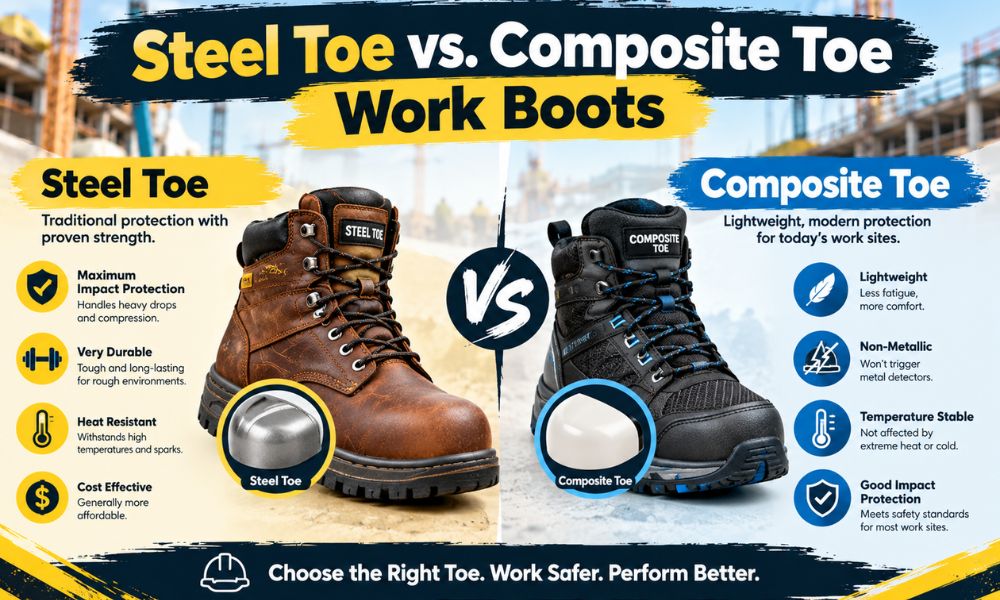
Neither is universally better. The right choice depends on weight preference, environment, comfort, and your workplace requirements. Here’s a clear comparison:
| Feature | Steel Toe | Composite Toe |
| Protection | Strong impact/compression protection | Strong impact/compression protection |
| Weight | Usually heavier | Usually lighter |
| Metal | Yes | No |
| Temperature considerations | Can feel colder/hotter | Generally less conductive |
| Electrical environments | Depends on complete boot rating | Depends on complete boot rating |
| Best for | Traditional heavy-duty applications | Workers wanting non-metallic protection |
Important: A composite toe does not automatically provide electrical protection. Electrical safety depends on the complete boot’s certification, rating, and intended use, not the toe material alone. Always verify the boot’s actual rating.
For a deeper internal comparison, you can also link to Steel Toe vs. Composite Toe Tactical Boots.
How to Choose Work Boots for Different Construction Jobs
Different trades face different hazards. Here’s how to match your boots to your work.
General Construction
Prioritize a safety toe, slip-resistant traction, solid durability, and all-day comfort. A well-rounded boot handles the mix of tasks most general laborers encounter.
Roofing
Look for lighter construction, excellent traction, and flexibility. Roofers need soles designed to grip sloped and sometimes hot surfaces. A boot that bends with your foot helps you stay stable and sure-footed.
Concrete Work
Concrete is wet, abrasive, and alkaline. Waterproof or water-resistant boots help here, along with reliable traction on slick slabs and durable materials that resist wear. Clean boots after exposure to protect the leather.
Electrical Work
Electrical workers should follow their workplace requirements and select footwear specifically rated for the applicable electrical hazards. Don’t assume any boot provides electrical protection; confirm the exact rating and its intended use with the manufacturer and your safety officer.
Framing and Carpentry
Framers benefit from good traction, flexibility, toe protection, puncture resistance, and comfort. Exposed nails and fasteners make puncture-resistant midsoles especially useful.
Heavy Equipment and Site Work
This demanding work calls for stronger toe protection, dependable ankle support, tough construction, and aggressive traction. Uneven terrain and heavy materials raise the stakes for both protection and stability.
Outdoor Construction
Weather is the main variable. Consider waterproofing, weather resistance, insulation in cold climates, and aggressive traction for mud and loose ground. Match insulation to your actual conditions so your feet stay comfortable, not overheated.
Whatever the trade, always match your footwear to the actual hazard assessment on your site. For readers comparing jobsite footwear types more broadly, a useful internal resource is How Tactical Boots Compare to Work Boots.
What Safety Ratings Should You Look For?
Pay attention to recognized safety standards and manufacturer markings rather than marketing language. A boot labeled “tough” or “heavy-duty” tells you nothing measurable. A certified rating does.
ASTM F2413 is the widely recognized standard for protective footwear performance. It addresses requirements such as impact and compression resistance for safety toes, and it covers additional properties like puncture resistance and electrical-hazard protection when a boot is specifically rated for them. Manufacturers mark compliant boots accordingly.
OSHA’s general-industry foot-protection regulation recognizes ASTM F2413 and other applicable consensus standards for protective footwear. For construction readers, the practical takeaway is simple: your employer’s and jobsite’s specific requirements always take priority. Confirm what your site demands, then buy boots that clearly meet those standards.
Never assume a boot meets a standard unless the manufacturer explicitly confirms it.
7 Features to Check Before Buying Construction Work Boots
Use this quick checklist when you shop:
- Safety-toe protection — steel or composite, matched to your hazards and site rules
- Slip-resistant traction — a tread designed for your work surfaces
- Puncture-resistant construction — protection against nails and sharp debris
- Waterproof or water-resistant protection — when your environment calls for it
- Durable upper and outsole — built to survive your daily conditions
- Comfortable fit and support — cushioning, arch support, and proper width
- Appropriate safety rating — a certified rating that meets your job’s requirements
If a boot checks the boxes that matter for your trade, it’s a strong candidate.
How Should Construction Work Boots Fit?
Construction boots should fit snugly without pinching, with room for your toes and a secure heel. Proper fit keeps you comfortable and helps your protective footwear work as intended.
When checking fit:
- Leave adequate room for your toes to move
- Make sure your heel stays reasonably secure and doesn’t lift
- Confirm your foot doesn’t slide around inside
- Match the width to your foot, not just the length
- Check for pressure points that could cause blisters
- Try boots on with the socks you actually wear at work
- Walk on a hard surface to feel the real fit
- Account for foot swelling after long hours
Footwear that doesn’t fit properly reduces comfort and can compromise usability, so take your time here.
Common Mistakes When Buying Construction Boots
Avoid these frequent errors:
- Choosing style over protection — looks won’t protect your feet
- Buying on price alone — the cheapest option often costs more in replacements
- Ignoring workplace hazards — always start with your actual risks
- Picking the wrong sole for the surface — smooth soles fail on wet or muddy ground
- Buying boots that are too tight — tight boots cause pain and fatigue
- Assuming all steel-toe boots offer identical protection — ratings vary
- Overlooking waterproofing needs — or adding it where you don’t need it
- Choosing heavy boots when flexibility matters more — match weight to the job
- Failing to inspect worn soles and damaged parts — worn boots lose protection
How Long Do Construction Work Boots Last?
There’s no universal replacement schedule. Boot lifespan depends on how often you work, your jobsite conditions, the materials, your maintenance habits, exposure to water, chemicals, mud, and concrete, how far you walk, and how quickly the sole wears.
Watch for these signs that replacement may be necessary:
- A damaged or compromised safety toe area
- The sole separating from the upper
- Deep cracks in the leather or sole
- Worn-down tread that no longer grips
- Loss of waterproofing
- Damaged or broken stitching
- A deformed or structurally compromised boot
When protection is compromised, replace the boots. Don’t rely on a fixed calendar; rely on their condition.
How to Maintain Construction Work Boots
Good maintenance preserves comfort and performance. Try these practical steps:
- Clean off dirt, mud, and debris regularly
- Let boots dry naturally after they get wet
- Avoid excessive heat when drying leather, which can crack it
- Follow the manufacturer’s care instructions
- Inspect soles and stitching often
- Replace worn or broken laces
- Use appropriate conditioners on compatible leather
- Rotate between two pairs when you can, so each dries fully
Keep in mind that maintenance can extend the life of your boots, but it cannot restore protective components once they’re compromised. When the structure or safety features are damaged, it’s time for a new pair.
Once you know which protection and comfort features you need, compare footwear designed for demanding outdoor and work environments. Army Navy USA offers a range of work and safety boot options from brands like Timberland PRO as well as rugged Matterhorn work boots worth exploring when evaluating your options.
Frequently Asked Questions
What are the best work boots for construction?
The best boots depend on your jobsite hazards, but commonly important features include safety-toe protection, slip resistance, puncture resistance, durability, a proper fit, and all-day comfort. Match these to your specific trade and conditions.
Are steel-toe boots good for construction?
Yes, steel-toe boots are appropriate for many construction jobs, especially where falling or rolling objects are a risk. Follow your employer and jobsite requirements to confirm the protection level you need.
Are composite-toe boots better than steel-toe boots?
Neither is universally better. Composite toes are usually lighter and non-metallic, while steel toes are a proven, traditional choice. The right pick depends on weight, environment, comfort, workplace requirements, and the boot’s certified safety rating.
Do construction workers need waterproof boots?
Waterproof boots are especially useful in wet environments like rain, mud, snow, and concrete work. They aren’t necessary for every job, though. In hot, dry conditions, breathable non-waterproof boots may be more comfortable.
What type of sole is best for construction work?
A slip-resistant, durable sole with traction matched to your surfaces is best. Choose an aggressive tread for mud and uneven ground, and a slip-resistant outsole for wet concrete and oily areas.
How should construction boots fit?
They should give your toes room, keep your heel secure, match your foot’s width, and avoid pressure points. Try them on with your work socks and walk on a hard surface to confirm comfort.
How often should construction work boots be replaced?
Replace them based on condition, not a fixed schedule. Signs include a damaged safety toe, sole separation, deep cracks, worn tread, lost waterproofing, or a compromised structure.
Conclusion
The best work boots for construction are the ones that match your specific hazards, provide appropriate protection, fit correctly, and stay comfortable throughout the workday. Start with your jobsite risks and safety requirements, choose the right safety toe, traction, and features for your trade, then confirm the fit and certified rating before you buy. Get those fundamentals right, and your boots will protect you shift after shift.
