

A flashlight is one of those pieces of gear you usually do not think about until you actually need one. A power outage, a dark trail, a late-night repair, or a vehicle problem can turn a simple flashlight into an essential tool.
But choosing one is not always as simple as picking the brightest model on the shelf. A flashlight that works well for checking equipment around a job site may not be the right choice for camping. Likewise, an ultra-bright tactical flashlight may be more than you need for keeping in a kitchen drawer for occasional emergencies.
The right flashlight depends on where you will use it, how often you will carry it, how much light you need, and what features matter most to you.
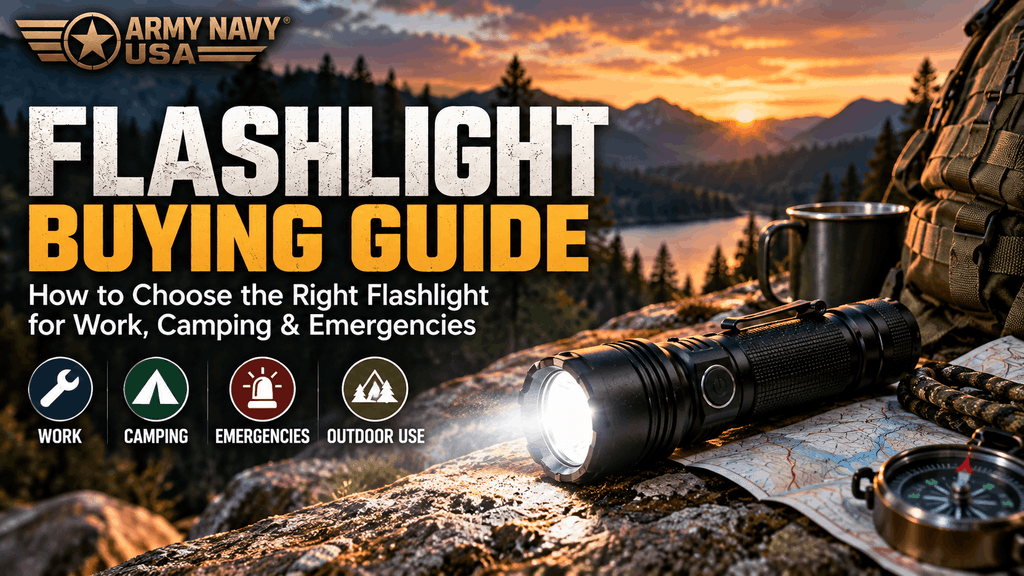
This flashlight buying guide explains the important features to consider, from lumens and beam distance to batteries, runtime, size, durability, and charging options. Whether you need a flashlight for work, camping, hiking, outdoor activities, or emergency preparedness, these tips can help you choose with confidence.
What Should You Look for in a Flashlight?
Before buying a flashlight, think about how you actually plan to use it. There is no single flashlight that is perfect for every situation.
For most buyers, the most important features are:
- Brightness
- Beam distance
- Runtime
- Battery type
- Size and weight
- Durability
- Water resistance
- Ease of carrying
- Charging options
- Light modes
A flashlight with thousands of lumens might sound impressive, but maximum brightness is only one part of the equation. A model with a useful beam, good battery life, durable construction, and a comfortable grip may be much more practical for everyday use.
Think About Your Main Use
Start with the situation where you will use the flashlight most often.
For work, look for durability, dependable runtime, and a comfortable design that is easy to carry.
For camping and hiking, weight, battery life, weather resistance, and beam distance become more important.
For emergency use, reliability matters. You may want a flashlight that can remain stored for long periods and still be ready when you need it.
For tactical or outdoor use, rugged construction, multiple light modes, strong beam performance, and convenient carry options can be useful.
The best flashlight for you is the one that matches your actual needs—not simply the one with the biggest number on the package.
Understanding Lumens: How Bright Does a Flashlight Need to Be?
Lumens measure the amount of visible light produced by a flashlight. In simple terms, a higher lumen rating generally means the flashlight can produce more light.
However, more lumens does not automatically mean a better flashlight.
A very bright flashlight can be useful when you need to illuminate a large outdoor area. But excessive brightness can be unnecessary for close-up work and can drain the battery faster.
For everyday tasks, a moderate output may be perfectly adequate. For camping, hiking, searching larger outdoor areas, or emergency situations, you may want a higher-output model.
Instead of asking, “How many lumens is the best flashlight?” ask:
“How much light do I actually need for the way I use it?”
That simple question can save you from buying something larger, heavier, or more powerful than necessary.
Beam Distance Matters Too
Brightness tells you how much light the flashlight produces, but beam distance tells you how far that light can effectively reach.
This becomes particularly important outdoors.
Imagine walking around a campsite after dark. You may want to see beyond your immediate surroundings rather than simply light the ground a few feet in front of you.
A flashlight designed for longer-range illumination can help you see objects farther away. On the other hand, a wider beam can be more useful when working close to you or walking through an area where you need broader visibility.
Flood Beam vs. Focused Beam
Flashlights generally produce different beam patterns.
A flood-style beam spreads light over a wider area. This can be useful for:
- Camping
- Walking
- Working on equipment
- Searching around a campsite
- General outdoor activities
A focused beam concentrates more light in a particular direction and can be useful when you need to see farther ahead.
Some modern flashlights offer adjustable beams, allowing you to change between wider and more focused illumination.
For an all-purpose flashlight, adjustable beam control can be a useful feature.
Flashlight Battery Types
Battery choice can have a major effect on convenience.
Traditional battery-powered flashlights are still useful because replacement batteries are easy to store and carry. They can be especially practical for emergency kits where you want a backup power source available without relying on a charging cable.
Rechargeable flashlights, meanwhile, can be convenient for frequent use. Instead of continually replacing disposable batteries, you can recharge the flashlight when the battery gets low.
Disposable Batteries
Common advantages include:
- Easy replacement
- Long-term storage options
- Convenient backup power
- No charging cable required
If you choose a battery-powered flashlight for emergency preparedness, it is smart to keep spare batteries stored nearby.
Rechargeable Flashlights
Rechargeable models can be convenient for people who use their flashlight regularly.
Advantages may include:
- Easy recharging
- Less need for disposable batteries
- Convenient everyday use
- Useful for work and frequent outdoor activities
The tradeoff is that you need access to a suitable charging method.
For emergency preparedness, some people prefer having both options available: a rechargeable flashlight for regular use and a battery-powered backup.
How Long Should a Flashlight Battery Last?
Runtime tells you how long a flashlight can operate under specified conditions.
But pay attention to how manufacturers present runtime figures. A flashlight may have a very long runtime on a low setting while lasting considerably less at maximum brightness.
This is why it is useful to look at runtime across different brightness modes, rather than focusing only on one number.
If you use a flashlight for several hours at a time while camping, runtime becomes particularly important.
For occasional household use, extremely long runtime may not be as important.
Again, your intended use should determine what matters most.
Flashlight Size and Weight
A flashlight that is too large to carry comfortably may end up staying at home.
For everyday carry, compact flashlights are often convenient because they take up less space and are easier to keep in a pocket, bag, or vehicle.
Larger flashlights can provide advantages such as:
- Higher light output
- Larger batteries
- Longer runtime
- More substantial grip
- Greater suitability for extended outdoor use
For camping or emergency storage, size may not matter as much because you can keep the flashlight in a backpack, gear bag, or emergency kit.
For everyday work, however, a comfortable and portable design can make a noticeable difference.
What Makes a Good Tactical Flashlight?
A tactical flashlight is generally designed with durability and practical performance in mind. Depending on the model, features may include rugged construction, multiple output levels, strong beam performance, water resistance, and a design intended for demanding environments.
Tactical flashlights can be useful for:
- Outdoor work
- Security-related tasks
- Camping
- Hiking
- Vehicle emergencies
- General preparedness
You do not necessarily need a tactical flashlight simply because you want a bright light. If you mainly need something for finding items in a dark room, a simpler flashlight may be enough.
If you regularly work outdoors or carry gear in demanding conditions, however, the additional durability can be worthwhile.
Water Resistance for Outdoor Use
Outdoor conditions can change quickly.
A flashlight used for camping, hiking, hunting, or other outdoor activities may be exposed to rain, wet ground, splashes, or moisture.
Look for the flashlight’s stated water-resistance rating and understand what that rating actually covers.
Water resistance does not mean every flashlight can be submerged indefinitely. The rating indicates the conditions the product is designed to handle.
For outdoor use, some level of water resistance is a valuable feature because you do not want a little rain to turn an important piece of gear into dead weight.
Flashlight Materials and Durability
Construction matters when a flashlight will be used regularly.
Flashlights designed for demanding environments may use materials such as aluminum or other durable materials that can withstand everyday knocks and drops.
Think about where you will use yours.
A flashlight sitting in a bedside drawer does not necessarily need the same level of ruggedness as one carried around a construction site, campsite, or outdoor work area.
If you expect your flashlight to see heavy use, look for a sturdy housing, dependable switches, and a design that feels solid in your hand.
Useful Flashlight Modes
Many modern flashlights offer several lighting modes rather than a single brightness level.
Depending on the model, these may include:
- Low
- Medium
- High
- Turbo
- Strobe
- SOS or emergency modes
Multiple modes can make a flashlight more versatile.
A low setting can be useful inside a tent or when reading a map without wasting unnecessary battery power. A higher setting can help when you need to illuminate a larger area.
An emergency mode may also be useful in certain situations.
However, more modes are not always better. If switching between modes is confusing or requires repeatedly pressing the button, a simple flashlight may actually be easier to use.
Choosing a Flashlight for Camping
Camping places different demands on a flashlight than everyday household use.
When choosing a camping flashlight, consider:
Battery life: You may not have access to electricity for extended periods.
Weight: Every item in a backpack adds up.
Beam pattern: A wider beam can be useful around camp.
Durability: Outdoor gear can take some abuse.
Water resistance: Rain and moisture are part of outdoor life.
Ease of use: You should be able to operate it quickly, even in the dark.
It is also worth carrying a backup light when heading into remote areas. A small secondary flashlight or headlamp can be useful if your primary light runs out of power.
Choosing a Flashlight for Work
For work, practicality usually matters more than flashy specifications.
If you work around vehicles, equipment, buildings, warehouses, construction areas, or outdoor job sites, look for a flashlight that is:
- Durable
- Comfortable to hold
- Easy to operate
- Bright enough for the task
- Reliable over extended use
- Convenient to carry
A rechargeable flashlight can be particularly convenient for workers who use one every day.
If you frequently need both hands free, consider whether a headlamp might be more suitable than a handheld flashlight.
Choosing a Flashlight for Emergencies
A flashlight belongs in almost every basic emergency kit.
Power outages, vehicle problems, storms, and unexpected situations can happen without warning.
For emergency preparedness, focus on reliability rather than unnecessary features.
Keep at least one flashlight somewhere that is easy to reach. A flashlight stored in a box at the back of a closet is not very useful during a sudden power outage.
It is also worth checking your emergency flashlight periodically. Test the light, inspect the batteries, and make sure everything is working before you actually need it.
Keeping a second flashlight in your vehicle or emergency bag can provide an additional backup.
Flashlight Buying Mistakes to Avoid
A few common mistakes can make choosing a flashlight harder than it needs to be.
Buying Based Only on Lumens
A huge lumen number does not tell you everything about a flashlight. Consider beam pattern, runtime, durability, and usability too.
Ignoring Battery Availability
A flashlight is only useful when it has power. Think about whether replacement batteries or charging options will be convenient for you.
Choosing Something Too Large
If you need an everyday flashlight, a bulky model may end up being left behind.
Forgetting About Runtime
Maximum brightness is impressive, but it may not be the setting you use most often.
Buying Features You Will Never Use
Strobe modes, multiple brightness settings, and advanced controls can be useful, but only if they actually suit your needs.
A Simple Flashlight Buying Checklist
Before purchasing, ask yourself:
- Where will I use the flashlight?
- Do I need it for work, camping, emergencies, or everyday carry?
- How bright does it really need to be?
- Do I need a long beam distance?
- How long should it run?
- Do I prefer rechargeable or replaceable batteries?
- Does it need to be water resistant?
- How much weight am I comfortable carrying?
- Do I need multiple lighting modes?
- Do I need a backup flashlight?
Answering these questions will narrow down your choices quickly.
Final Thoughts
The right flashlight does not have to be the biggest, brightest, or most expensive model available. It simply needs to perform well for the situations where you plan to use it.
For work, prioritize durability, comfortable handling, and dependable runtime. For camping and hiking, consider weight, beam performance, battery life, and weather resistance. For emergency preparedness, reliability and easy access should be at the top of your list.
A good flashlight is a small piece of equipment, but it can make a big difference when visibility matters. Take a few minutes to think about your needs before buying, and you will have a much better chance of choosing a flashlight that you will actually use and rely on.
Ready to upgrade your outdoor and everyday gear? Explore Army Navy USA’s selection of flashlights and outdoor equipment to find practical gear for work, camping, emergencies, and more.
Whether you are putting together an emergency kit, preparing for a camping trip, or simply replacing an old flashlight, choosing the right combination of brightness, battery life, beam distance, durability, and portability will help you get more from your gear.
