

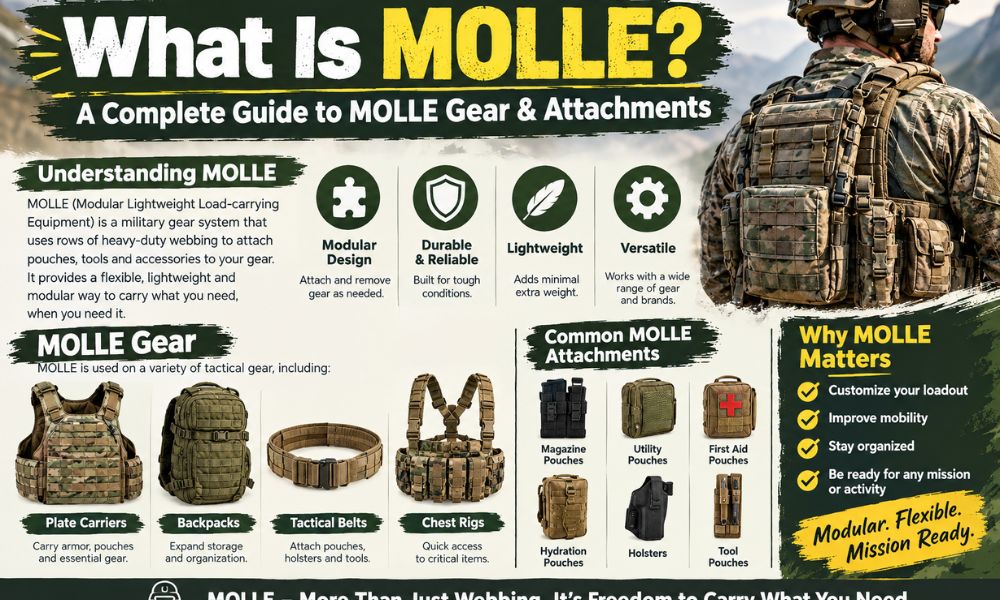
Look at almost any modern tactical backpack, vest, or plate carrier and you’ll notice rows of sturdy nylon straps stitched across the surface. Those straps aren’t just for looks. They’re part of a modular system that lets you add pouches, tools, and accessories exactly where you want them. This system is why gear built for soldiers, police officers, hikers, and everyday users can be customized so easily.
If you’ve ever wondered what is MOLLE and why it shows up on so much equipment, this guide breaks it down in plain language. Once you understand MOLLE and the PALS webbing behind it, choosing and setting up compatible gear becomes far simpler.
What Is MOLLE?
MOLLE stands for Modular Lightweight Load-carrying Equipment. It’s a modular system used on tactical and outdoor gear that lets you attach pouches and accessories to compatible webbing. Instead of fixed storage, MOLLE lets users tailor their setup by adding or removing items based on their needs.
The U.S. Army describes MOLLE as a system designed to let users adjust their load to fit mission requirements. That flexibility is the whole point. You decide what goes where.
What Does MOLLE Stand For?
MOLLE stands for Modular Lightweight Load-carrying Equipment. It’s usually pronounced “Molly.”
Here’s what each part means:
- Modular – You can add, remove, or rearrange components freely.
- Lightweight – The system uses durable but relatively light materials.
- Load-carrying – It’s built to help you carry and organize gear.
- Equipment – It refers to the full family of compatible packs, vests, and pouches.
Put simply, MOLLE is a flexible way to build and adjust your gear setup.
How Does MOLLE Work?
MOLLE works by using rows of webbing as attachment points. Pouches connect to that webbing through interwoven straps, holding everything firmly in place.
Here’s the basic process:
- Base platform – A backpack, vest, or belt with rows of webbing.
- PALS webbing – The grid of horizontal straps sewn onto the base.
- Compatible pouch or accessory – The item you want to attach.
- Attachment straps – The straps on the back of the pouch.
- Interweaving – Threading those straps through both the base webbing and the pouch.
- Securing – Locking the strap in place at the end of the weave.
Weaving the straps correctly matters. When done right, the pouch barely moves and stays in the same spot every time you reach for it. Skipping the weave leads to bouncing and shifting gear.
What Is PALS Webbing?
PALS stands for Pouch Attachment Ladder System. It’s the grid of webbing that makes modular attachment possible.
Traditional PALS webbing looks like rows of one-inch-wide horizontal straps stitched down at regular intervals. Those stitch points create small loops that attachment straps can pass through. You’ll find PALS on backpacks, vests, plate carriers, belts, and even the backs of many pouches.
Think of PALS as the “attachment grid” and MOLLE as the broader system built around that grid. Because the two work together so closely, people often use the names interchangeably. That’s why PALS is frequently confused with MOLLE, even though they describe different things.
MOLLE vs. PALS: What’s the Difference?
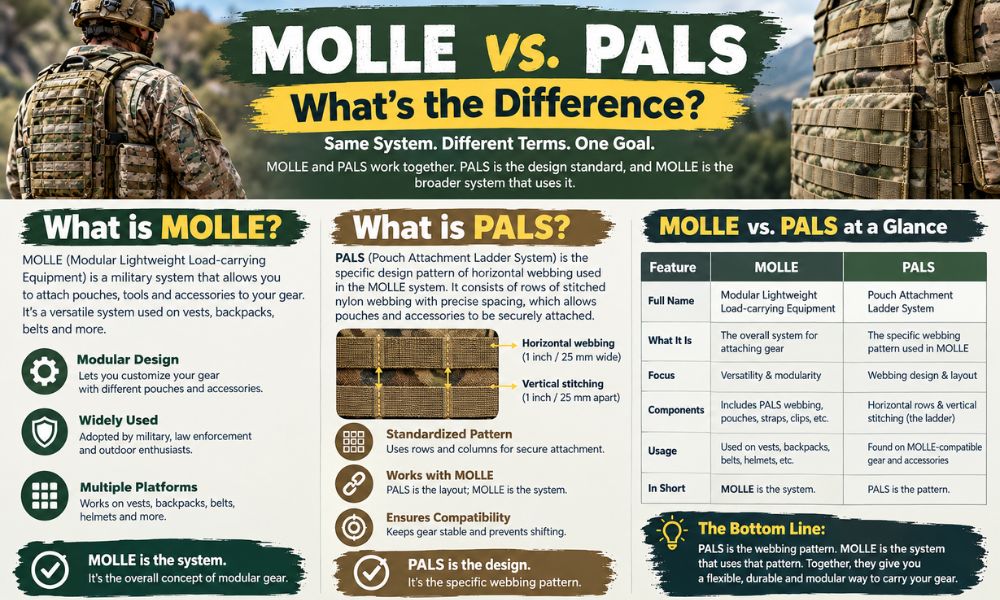
The simplest way to remember it: MOLLE is the overall system, and PALS is the webbing that makes it work.
MOLLE refers to the modular gear and how it’s designed to carry a load. PALS refers specifically to the ladder-style webbing that lets compatible attachments connect. You need PALS webbing for MOLLE gear to function, but they aren’t the same word for the same thing.
| Feature | MOLLE | PALS |
| Meaning | Modular Lightweight Load-carrying Equipment | Pouch Attachment Ladder System |
| What it describes | Gear/system | Webbing/attachment interface |
| Main purpose | Modular load carrying | Attaching compatible equipment |
| Common locations | Packs, vests, load-bearing gear | Packs, vests, carriers, pouches |
Keep this distinction clear and you’ll understand product listings much faster.
A Brief History of MOLLE
MOLLE was developed as a more adaptable replacement for older U.S. military load-carrying systems. The goal was to let soldiers configure their equipment around specific mission needs rather than being stuck with fixed storage.
Before MOLLE, the military relied on systems like ALICE (All-purpose Lightweight Individual Carrying Equipment) and later the IIFS (Integrated Individual Fighting System). Both carried gear effectively but offered less flexibility for rearranging components.
U.S. Army documentation identifies MOLLE as introduced in the late 1990s, with wider field issue happening in the years that followed. Exact rollout dates varied across units, so it’s best to rely on official military records rather than fixed claims. What matters most is the shift the system represented: moving toward gear that users could truly customize.
Types of MOLLE Gear and Attachments
MOLLE covers a wide range of equipment. Most items either provide attachment points or attach to them.
MOLLE Backpacks
MOLLE backpacks feature external webbing across the front and sides. This lets you expand storage by adding pouches instead of buying a bigger pack. It’s a practical way to scale your setup as needs change.
MOLLE Pouches
Pouches are the most common attachment. Popular types include:
- Utility pouches – General storage for tools and small items.
- Magazine pouches – Sized to hold magazines securely.
- Medical/first-aid pouches – Quick access to medical supplies.
- Hydration pouches – Carry water bladders or bottles.
- Admin pouches – Organize documents, pens, and small essentials.
MOLLE Tactical Vests
Tactical vests use webbing across the chest and back so you can position gear where it’s easiest to reach. This keeps frequently used items close at hand.
MOLLE Belts
MOLLE belts hold compatible pouches around the waist. They help distribute weight and free up space on a pack or vest.
MOLLE Plate Carriers and Load-Bearing Equipment
Plate carriers and load-bearing rigs use modular attachment points to organize essentials. Users arrange pouches based on comfort, balance, and access.
MOLLE Accessories
Beyond pouches, you’ll find tool holders, gear organizers, hydration carriers, and utility panels. These extras help fine-tune any setup.
When building a configuration, experienced users usually organize gear around four things: accessibility (keep essentials within reach), weight distribution (balance heavier items near the body), frequency of use (place daily items in prime spots), and intended activity (a hiking loadout differs from a work loadout).
How to Attach MOLLE Gear Correctly
Attaching a MOLLE pouch takes patience, but the payoff is gear that stays put. The key is weaving through both the pouch and the base webbing, not just one layer.
Follow these steps:
- Choose a compatible platform – Confirm the base uses MOLLE/PALS webbing.
- Select the right pouch – Pick one sized for what it will hold.
- Position it – Place it where you can reach it comfortably.
- Start weaving – Thread the pouch strap through the first row of base webbing.
- Alternate rows – Pass the strap through the pouch webbing, then the next base row, continuing down.
- Secure the end – Snap or tuck the strap so it locks in place.
- Check for movement – Give it a firm tug; it shouldn’t slide or bounce.
- Test access – Make sure you can open and use it easily before heading out.
Simply hanging a pouch over the webbing without weaving it through will lead to shifting and wobble. The extra minute spent weaving is always worth it.
Benefits of MOLLE Gear
The biggest advantage of MOLLE is control over your setup. You build the exact configuration you need.
Key benefits include:
- Configurability – Arrange gear to match any task.
- Organization – Keep items separated and easy to find.
- Accessibility – Position essentials where you can grab them fast.
- Adaptability – Reconfigure for different activities in minutes.
- Efficient use of space – Make the most of available webbing.
One honest note: MOLLE isn’t automatically lighter or more comfortable than every other system. Load up too many pouches and it can get heavy. The real strength is flexibility and modularity, not a guarantee of comfort.
What Should You Look for When Buying MOLLE Gear?
Before buying, check that the pouch and base will actually work together. Not all MOLLE gear is universally interchangeable, so a quick review saves frustration later.
Use this checklist:
- Compatibility – Confirm the pouch and base use matching attachment systems.
- Webbing configuration – Check spacing and row count on the base.
- Attachment method – Some pouches weave, others snap or clip.
- Pouch dimensions – Make sure the size fits the space available.
- Available attachment space – Count the rows and columns you have to work with.
- Manufacturer design – Designs vary, and some fit tighter than others.
- Intended load – Match the pouch strength to what you’ll carry.
- Material quality – Look at stitching, webbing, hardware, and reinforcement.
- Size – Choose based on the equipment it needs to hold.
- Placement – Avoid spots that block movement or other gear.
- Weight – Remember each added pouch increases your total load.
- Intended use – Work, hiking, camping, travel, emergency prep, and tactical use all have different needs.
Is MOLLE Only Used by the Military?
No. While MOLLE started with the military, MOLLE-style webbing now appears across many types of gear.
You’ll find it used by:
- Military personnel
- Law enforcement officers
- Hikers and campers
- Tradespeople and work crews
- Travelers
- Emergency-preparedness planners
- Everyday recreational users
Keep one thing in mind, though. There’s a difference between authentic military-issued MOLLE equipment and commercial gear that simply uses PALS-style webbing. Both can serve you well, but they aren’t always identical in build or specification.
MOLLE Gear at Army Navy USA
If you’re ready to build or expand your setup, it helps to start with a reliable source. For a broad selection of military and tactical gear with modular functionality, Army Navy USA is a solid place to explore packs, vests, pouches, and accessories that fit your intended configuration.
Take a little time to match your gear to your activity, and you’ll end up with a setup that works the way you need it to.
Frequently Asked Questions About MOLLE
What is MOLLE in simple terms?
MOLLE is a modular system of webbing and attachments that lets you customize tactical and outdoor gear. Instead of fixed pockets, it uses rows of straps where you can add or remove pouches. This means you build your own layout based on what you need to carry.
What does MOLLE stand for?
MOLLE stands for Modular Lightweight Load-carrying Equipment. It’s usually pronounced “Molly.” The name reflects its purpose: a lightweight, adjustable way to carry and organize gear. The system was developed for the U.S. military and is now common on backpacks, vests, belts, and plate carriers used by many groups.
What is the difference between MOLLE and PALS?
MOLLE is the broader modular load-carrying system, while PALS (Pouch Attachment Ladder System) is the webbing grid that makes attachment possible. In short, PALS is the interface, and MOLLE is the overall gear system built around it. They work together, which is why the terms are often confused.
How do you attach a MOLLE pouch?
Weave the pouch’s straps through both the base webbing and the pouch webbing, alternating row by row, then secure the end strap. Give the pouch a firm tug to confirm it doesn’t shift. Proper weaving keeps gear stable, while simply hanging a pouch over the straps causes unwanted movement.
Is MOLLE webbing universal?
Not entirely. MOLLE and PALS webbing follows common patterns, but spacing, stitching, and manufacturer design can vary. Most standard pouches fit most standard bases, yet exact fit isn’t guaranteed. Always check compatibility, webbing configuration, and available space before assuming a pouch will attach cleanly to your platform.
Can MOLLE pouches be used on any tactical backpack?
Only if the backpack has compatible MOLLE/PALS webbing. A pouch designed for one system may not weave properly onto every pack. Check the webbing configuration, attachment method, and available space first. Some designs fit tighter or looser than others, so a quick compatibility check prevents surprises.
Is MOLLE only used for military gear?
No. MOLLE-style webbing is now common in outdoor, work, travel, emergency-preparedness, law enforcement, and recreational gear. The military created the system, but its flexibility made it popular everywhere. Just remember that authentic military-issue equipment and commercial PALS-style gear aren’t always built to identical specifications.
What should I look for when buying MOLLE equipment?
Focus on compatibility, webbing configuration, attachment method, pouch size, and available space. Check material quality, including stitching, hardware, and reinforcement. Consider placement, added weight, and your intended use. Since not all MOLLE gear is interchangeable, matching the pouch to your specific platform is the most important step.
