

A good pair of work pants should make your day easier, not give you something else to think about.
If you’ve ever spent a full shift pulling at a waistband, climbing into a truck with stiff fabric, or trying to squeeze tools into pockets that were never designed for them, you already know what a difference the right pants can make.
The best work pants aren’t necessarily the heaviest or most expensive pair on the rack. What matters is finding a pair that fits the work you actually do.
Someone working construction may need durable work pants for men with reinforced areas and useful pockets. Someone spending the day moving between a warehouse and a job site may want lightweight fabric and a little stretch. For outdoor work, weather resistance can matter more than anything else.
So before you buy work pants, think about your job, your routine, and what you expect your pants to handle.
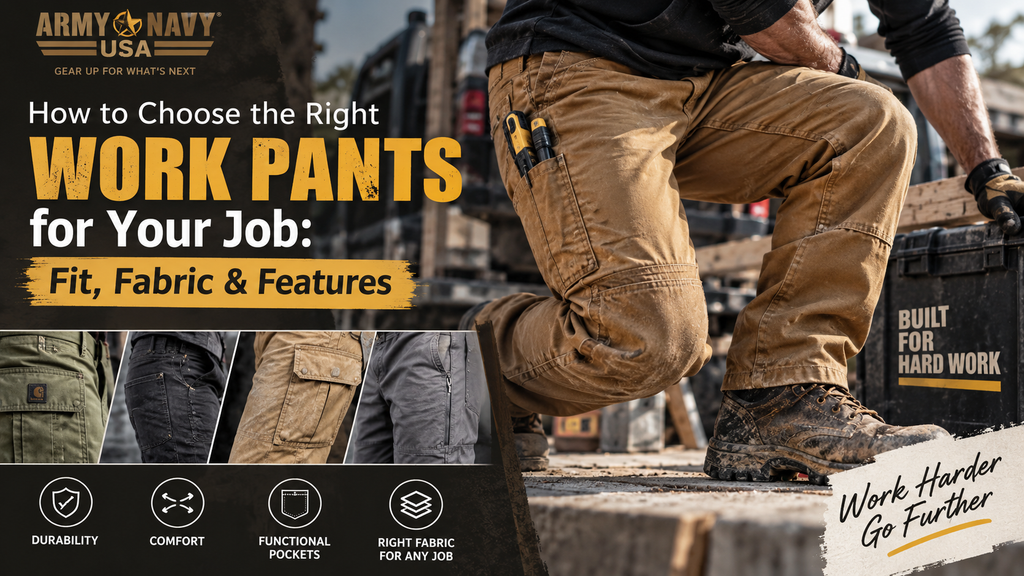
Start With the Job, Not the Pants
It’s tempting to start with a brand or a particular style. But your work should come first.
Think about a normal day.
Are you kneeling, climbing, lifting, driving, walking, or carrying tools? Are you working indoors, outside, or moving between both? Do you spend most of your shift on your feet?
These simple questions can narrow down your choices surprisingly quickly.
For example, a carpenter may benefit from work pants with tool pockets and a durable fabric that can handle frequent kneeling and movement. Someone working in maintenance may prefer utility work pants with several easy-access pockets. A warehouse worker might appreciate lighter men’s work pants that allow more movement during a long shift.
There isn’t one pair of pants that works perfectly for every job. The goal is to find the features that make sense for yours.
1. Get the Fit Right
Durability doesn’t matter much if the pants are uncomfortable.
A pair of work pants should give you enough room to move without becoming excessively loose. Pay attention to the waist, seat, thighs, knees, and leg opening.
If you’re climbing ladders, squatting, or bending throughout the day, you need room through the seat and thighs. If you spend more time standing or walking, a comfortable straight or relaxed fit may be easier to wear for long hours.
This is particularly important when looking for comfortable work pants for long hours. A pair that feels fine for ten minutes in a store can feel very different after eight or ten hours on the job.
Relaxed Fit vs. Regular Fit
Relaxed-fit pants generally provide more room through the seat and thighs, which can be useful for physically demanding jobs.
A regular or straight fit gives you a more traditional silhouette while still allowing everyday movement.
Don’t choose a fit simply because it looks good on a product photo. Think about what happens when you’re actually working.
2. Choose the Right Fabric
Fabric can completely change how a pair of work pants feels.
Traditional cotton or cotton-blend fabrics are popular because they’re comfortable and familiar. Canvas and heavier fabrics can provide additional durability for demanding jobs, while lighter blends can be more comfortable when you’re moving around all day.
Stretch fabrics are another useful option. A little flexibility can make a noticeable difference when you’re climbing, kneeling, or reaching.
For cold conditions, fleece-lined work pants or other insulated options can help keep you comfortable. For warmer environments, lighter-weight work pants may be the better choice.
The important thing is to match the fabric to your working conditions rather than automatically choosing the heaviest material available.
3. Think About Durability
Work pants are going to take more abuse than everyday casual pants.
Knees may hit the floor. Pockets may carry tools. Fabric may rub against equipment, wood, concrete, or metal. That’s why durability is one of the first things to consider when comparing best work pants for construction and other demanding jobs.
Look for details such as:
- Reinforced stitching
- Durable fabric
- Strong belt loops
- Reinforced stress points
- Reliable closures
- Useful pocket construction
If your job is particularly demanding, heavy duty work pants may make more sense than lightweight everyday trousers.
But don’t assume heavier automatically means better. If you’re working in a warm environment and constantly moving, extremely heavy fabric may become uncomfortable.
4. Don’t Underestimate the Pockets
For many workers, pockets are one of the most important features.
A good pocket layout can save you from constantly walking back to a toolbox, truck, or workbench.
Think about what you normally carry:
- Tape measure
- Utility knife
- Small tools
- Phone
- Keys
- Wallet
- Pen or marker
- Gloves
- Work accessories
If you regularly carry equipment, look at cargo work pants or utility styles with additional storage.
Cargo pants can be particularly useful for jobs where having frequently used items within reach saves time.
For carpenters and tradespeople, carpenter jeans and Carhartt carpenter jeans can also be worth considering because they’re designed around the needs of hands-on work.
The key is not simply having more pockets. It’s having pockets that you can actually use.
5. Consider Cargo, Utility and Tactical Styles
Not every worker needs traditional five-pocket work pants.
Depending on your job, cargo pants, utility pants, or tactical pants may offer a more practical setup.
Cargo pants provide additional storage and can be useful for maintenance, outdoor work, and jobs where carrying small equipment is part of the routine.
Utility pants offer a practical middle ground for workers who need extra storage without wanting an overly bulky design.
Tactical pants are another option for people who need mobility, multiple pockets, and durable construction for work or outdoor activities.
The best choice comes down to how much you carry and how you move throughout the day.
6. Match Your Pants to the Weather
Your work environment matters just as much as your job title.
Working outside in winter is very different from working inside a heated warehouse.
For colder conditions, consider insulated work pants, fleece-lined options, or layering-friendly designs. In wet conditions, water-resistant or weather-resistant fabrics may be more practical.
For warmer jobs, look for breathable and lightweight materials that won’t feel overly heavy after several hours.
If you’re working outdoors regularly, you may also want to look beyond pants and build your workwear around the conditions.
For example, you can pair your pants with work jackets, work shirts, work vests, and appropriate work boots depending on the season and job.
7. Think About the Rest of Your Workwear
Work pants rarely work alone.
Your pants should make sense with the rest of what you wear.
A construction worker might pair durable pants with work boots, a work shirt, and a work jacket during colder months.
Someone working outdoors may need work gloves, a weather-resistant jacket, and additional layers.
If visibility is important on your job, high visibility workwear can also become an important part of your setup.
For colder working conditions, work coveralls can provide another option when you need more coverage and protection.
Building your workwear this way makes more sense than buying individual pieces without thinking about how they work together.
8. Consider the Type of Work You Actually Do
Here’s a simple way to narrow your options.
Construction and Trades
Construction workers often need durable work pants for men that can handle kneeling, climbing, lifting, and frequent movement.
Look for durable fabric, reinforced construction, comfortable fits, and useful tool storage.
Carpentry
Carpenters may want pants designed around tools and frequent movement. Carpenter jeans, utility styles, and pants with dedicated tool pockets can be practical choices.
Warehouse and Maintenance
For warehouse and maintenance work, comfort becomes especially important when you’re moving throughout a long shift.
Look for comfortable work pants for long hours, practical pockets, and fabric that allows easy movement.
Outdoor Work
Outdoor workers should consider weather, temperature, and durability.
Depending on the season, lightweight work pants, insulated work pants, or weather-resistant options may be more suitable.
Everyday Workwear
If you want one pair that can move between work and everyday use, look for a balance between durability, comfort, and a clean fit.
This is where versatile work pants for men can make sense because they don’t have to be overly specialized.
9. What About Work Jeans?
Work pants aren’t always the answer.
For some jobs, work jeans are the better choice.
Denim can provide the familiar feel and durability that many workers prefer, while styles such as relaxed-fit, utility, cargo, and carpenter jeans offer different levels of functionality.
If you already like wearing jeans and want something designed for harder use, Carhartt work jeans and other work-focused denim options are worth exploring.
The right choice comes down to what feels comfortable and practical during your normal workday.
10. Brand Matters — But It Isn’t Everything
A familiar brand can make shopping easier because you may already know how its clothing fits and performs.
Brands such as Carhartt, Dickies, Rothco, and Propper are well known across different areas of workwear and utility clothing.
But don’t buy a pair simply because you recognize the name.
Look at the actual product.
Check the fabric, fit, pocket arrangement, construction, intended use, and available sizes. A great pair of pants for one worker may not be the right pair for another.
That’s why comparing the features is more useful than choosing based on a logo alone.
A Simple Work Pants Checklist
Before buying your next pair, ask yourself:
What kind of work do I do?
Construction, maintenance, warehouse work, outdoor work, or everyday use?
How much movement do I need?
If you’re bending, climbing, kneeling, or lifting regularly, prioritize mobility.
What do I carry?
Choose standard pockets, cargo storage, or tool-focused pockets based on your needs.
What weather will I work in?
Consider lightweight, insulated, fleece-lined, or weather-resistant options.
How long will I wear them?
For long shifts, comfort and fit become just as important as durability.
What do I already wear?
Make sure your pants work with your boots, shirts, jackets, gloves, and other gear.
Finding Work Pants That Fit Your Day
The best work pants aren’t necessarily the ones with the longest feature list.
They’re the ones you can put on in the morning, get through your shift, and barely think about.
For one worker, that could mean a pair of tough canvas pants with reinforced construction. For another, it could be lightweight cargo pants with stretch and plenty of storage. Someone else may prefer classic work jeans or carpenter pants.
Start with the job. Then think about fit, fabric, durability, pockets, weather, and comfort.
Once you know what you actually need, finding the right pair becomes much easier.
Ready to Find Your Next Pair?
If you’re looking for work pants for men, cargo work pants, utility work pants, or durable options for demanding jobs, explore the workwear selection at Army Navy USA and compare styles designed for different types of work.
You shouldn’t have to think about whether the waistband is digging in, whether the fabric will hold up, or where you’re going to put your tools. When the fit, fabric, storage, and durability match your job, your pants simply do their job while you focus on yours.
That’s really what good workwear is about: practical gear that works with you, not against you.
